
Travel Photography Gear Essentials
Travel photography rewards quick access and redundancy more than a bag full of lenses. The useful accessory is the one that prevents a missed frame, protects irreplaceable files, or keeps a small weather problem from ending the day.
This guide assumes you already have a camera and a lens that suits the trip. We compared current manufacturer specifications, recent photography coverage, and live retail activity to choose five accessories that solve distinct problems. It is researched curation, not a claim that we personally tested every product, and we do not publish prices that can change overnight.
The quick verdict
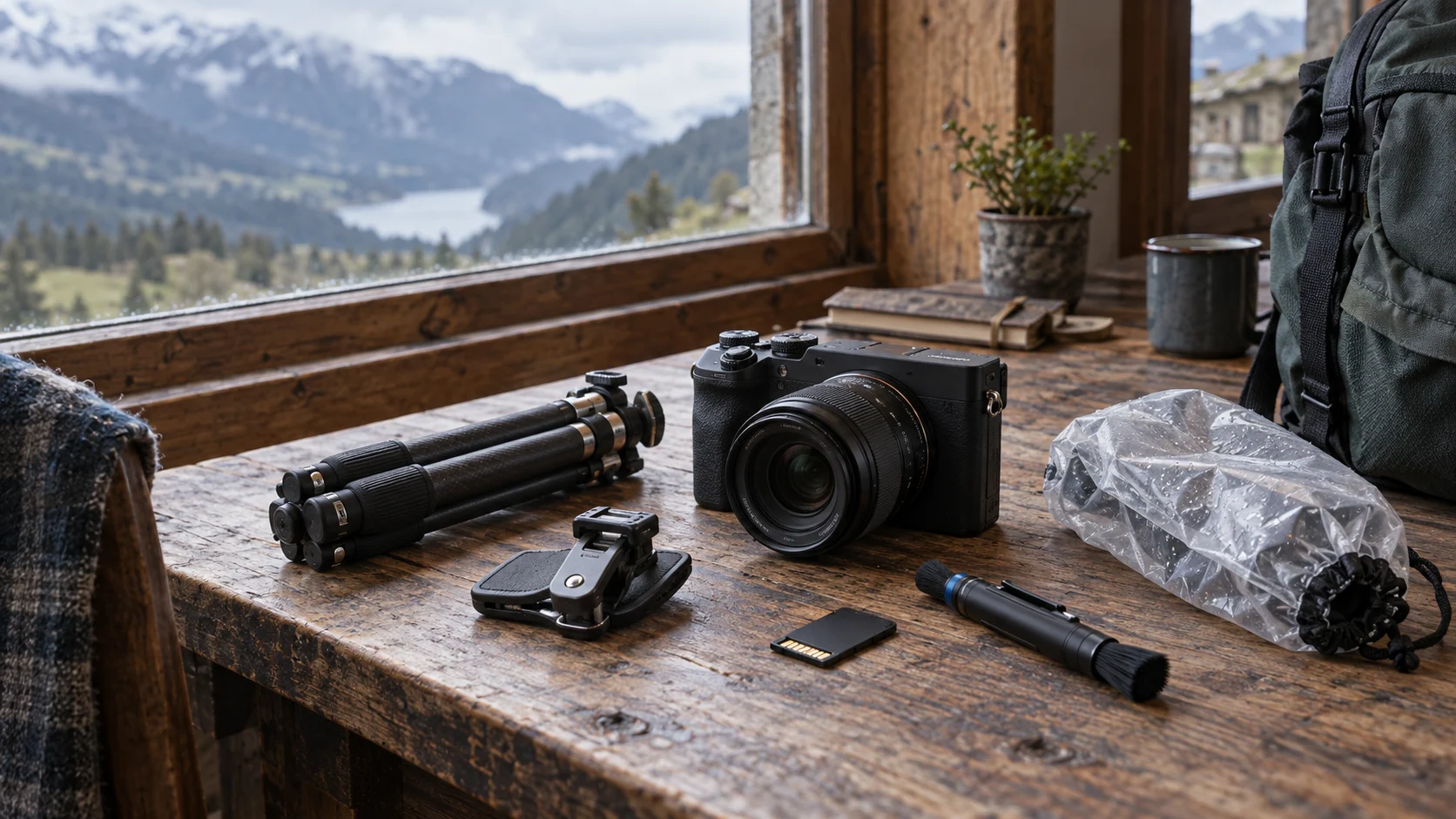
The Peak Design Capture Clip V3 is the most useful upgrade for photographers who miss shots while a camera is buried in a bag. A compatible SanDisk Extreme PRO 256GB UHS-I card covers storage, while the K&F Concept 64-inch Travel Tripod adds low-light and long-exposure capability at a reasonable cost. The LensPen NLP-1 handles everyday lens smudges in almost no space. An Altura Photo Camera Rain Cover is cheap insurance when the forecast turns.
None is universally essential. A street photographer may leave the full-size tripod at home; an architecture or landscape photographer may consider it non-negotiable. Recent TechRadar travel-photography advice reaches a similar conclusion: tripod, dependable storage and cleaning tools matter more than a pile of novelty accessories.
How we chose
Each item had to fix a common failure point while remaining compact enough for cabin baggage. We prioritized broad compatibility, replaceable or standardized parts, clearly published specifications, strong current retail signals, and a sensible cost relative to the camera it protects.
We deliberately did not choose a camera body, lens, battery or charger. Those depend on mount and model. Before ordering any accessory, check your camera’s card format, tripod plate, lens diameter, battery type and weather-sealing limits.
1. Peak Design Capture Clip V3: best camera access
Capture clamps to a backpack strap or belt and locks the camera into an included plate. Pressing the release removes the camera quickly; a secondary lock reduces the chance of an accidental release. Unlike a loose neck strap, the camera stays close to the body while walking.
Peak Design’s V3 product information describes an all-metal clip and an Arca-compatible Standard Plate. That tripod compatibility can reduce plate swapping. The clip still needs a firm, suitably sized strap, and a heavy body with a long lens can twist a soft backpack harness or feel unbalanced. Always tighten both bolts evenly and use a separate safety tether in exposed situations.
Best for: hiking, city walks, and fast access with a compact mirrorless or DSLR kit.
Skip it if: your shoulder strap is very thick, soft, or narrow, or your camera stays discreetly inside a bag.
2. SanDisk Extreme PRO 256GB UHS-I: best everyday SD card
The current 256GB Extreme PRO SD UHS-I card is rated U3 and V30. SanDisk specifies up to 250 MB/s read and 170 MB/s write for the new 256GB–1TB generation, with the important caveat that peak speeds require compatible hardware and real performance varies.
V30 guarantees a minimum sustained write class of 30 MB/s, useful for many 4K and burst-photo modes—but “many” is not “all.” Cameras that require UHS-II, V60, V90, CFexpress or a particular approved-card list need something else. For a long trip, two smaller cards can be safer than one enormous card because a failure or loss does not contain the entire journey.
Best for: compatible UHS-I cameras shooting stills and common 4K modes.
Skip it if: your camera manual calls for UHS-II, V60/V90, CFexpress, or lower maximum capacity.
3. K&F Concept 64-inch Travel Tripod: best value
This four-section aluminum tripod reaches about 163 cm, folds to 39 cm and weighs roughly 1.24 kg including its 28 mm ball head, according to K&F Concept. Those are useful numbers for a tripod that can fit inside or alongside a travel pack without consuming a premium-camera budget.
The listed 8 kg maximum load is not a promise of vibration-free long exposures at full height. Stability declines as the center column rises, leg sections narrow, or wind increases. Keep the thickest leg sections extended first, lower the center column, disable lens stabilization if your camera manual recommends it on a tripod, and use a delayed shutter or remote release.
Best for: landscapes, blue-hour city scenes, self-portraits, and occasional long exposures.
Skip it if: you will not use a tripod or need professional stability in strong wind.
4. LensPen NLP-1: best pocket cleaner
The NLP-1 combines a retractable brush for loose dust with a capped cleaning tip for fingerprints and smudges. It needs no bottle of liquid, fits in a small pouch and is less wasteful than packing dozens of single-use wipes.
Technique matters. First blow or brush away grit; rubbing a sandy lens can scratch a coating. Use the cleaning tip only on lens or filter glass as directed, not on an exposed camera sensor. Replace a contaminated or worn tool rather than grinding yesterday’s dust back into the front element. LensPen also warns that imitations exist, so use a reputable seller and inspect the packaging.
Best for: fingerprints, light dust, and a compact day-to-day cleaning kit.
Skip it if: you need wet cleaning, sensor cleaning, or removal of salt spray and stubborn residue.
5. Altura Photo Camera Rain Cover: best rain protection
This reusable sleeve surrounds a camera and mounted lens, with hand openings and a clear rear panel for seeing the controls. It packs much smaller than a dedicated weatherproof housing and can keep direct rain, spray and blowing grit off the camera during a short outdoor session.
Treat it as a rain jacket, not an underwater enclosure. It does not make an unsealed camera waterproof, and condensation can still form when moving between temperatures. Check that its lens opening suits your hood and that the combined camera-and-lens length is within the cover before leaving home.
Best for: forecast uncertainty, waterfalls, boats, and outdoor events in rain.
Skip it if: you need submersion protection or a fitted cover for an unusually long lens.
The essentials that must match your camera
Pack at least one genuine or reputable compatible spare battery and the correct charger. Protect spare battery terminals and keep them in cabin baggage. The FAA PackSafe guidance recommends carrying battery-powered devices in the cabin and requires spare lithium batteries in carry-on baggage; airlines can impose additional limits.
For files, follow a simple 3-2-1 principle where practical: three copies, on two kinds of storage, with one copy in a different place. On a short trip, that may mean leaving images on the card, copying them to a small SSD, and uploading selected work when a trusted connection is available. Formatting a card is not a backup.
Pack lighter and shoot more
Choose one versatile lens before adding a second. Put the camera where it can be reached without placing the entire bag on the ground. Keep the cleaning pen and a spare card in the same small pocket every day. If the tripod has not supported a planned shot on your itinerary, leave it home.
Add the camera, lens, exact battery count, charger, cards and backup plan to your journeybot packing list. Specific nouns prevent the classic travel-photography failures: “camera gear” is easy to check off while the battery is still charging on the kitchen counter.
FAQ
What photography gear is essential for travel?
Start with the camera and one versatile lens, then add a spare battery, compatible memory cards, a safe carrying method, basic lens cleaning, and weather protection. Add a tripod only when low light, landscapes, self-portraits, or long exposures justify its weight.
Should camera batteries go in carry-on luggage?
Yes. Spare lithium batteries belong in carry-on baggage with their terminals protected, not loose in a checked suitcase. Airline and national limits can differ, especially above 100 Wh, so check the current rules before flying.
Is a V30 SD card fast enough for travel photography?
V30 is sufficient for many stills and common 4K recording modes, but not every camera or high-bitrate codec. Check the camera manual for the required card type, bus and sustained write-speed class before buying.
Can I bring a tripod in carry-on luggage?
Tripods are often accepted in carry-on baggage when they fit the size limit, but security officers and airlines make the final decision. Sharp spikes, oversized heads, and long metal legs can create problems, so confirm the rules for your route.