
Best Travel Coffee Gear
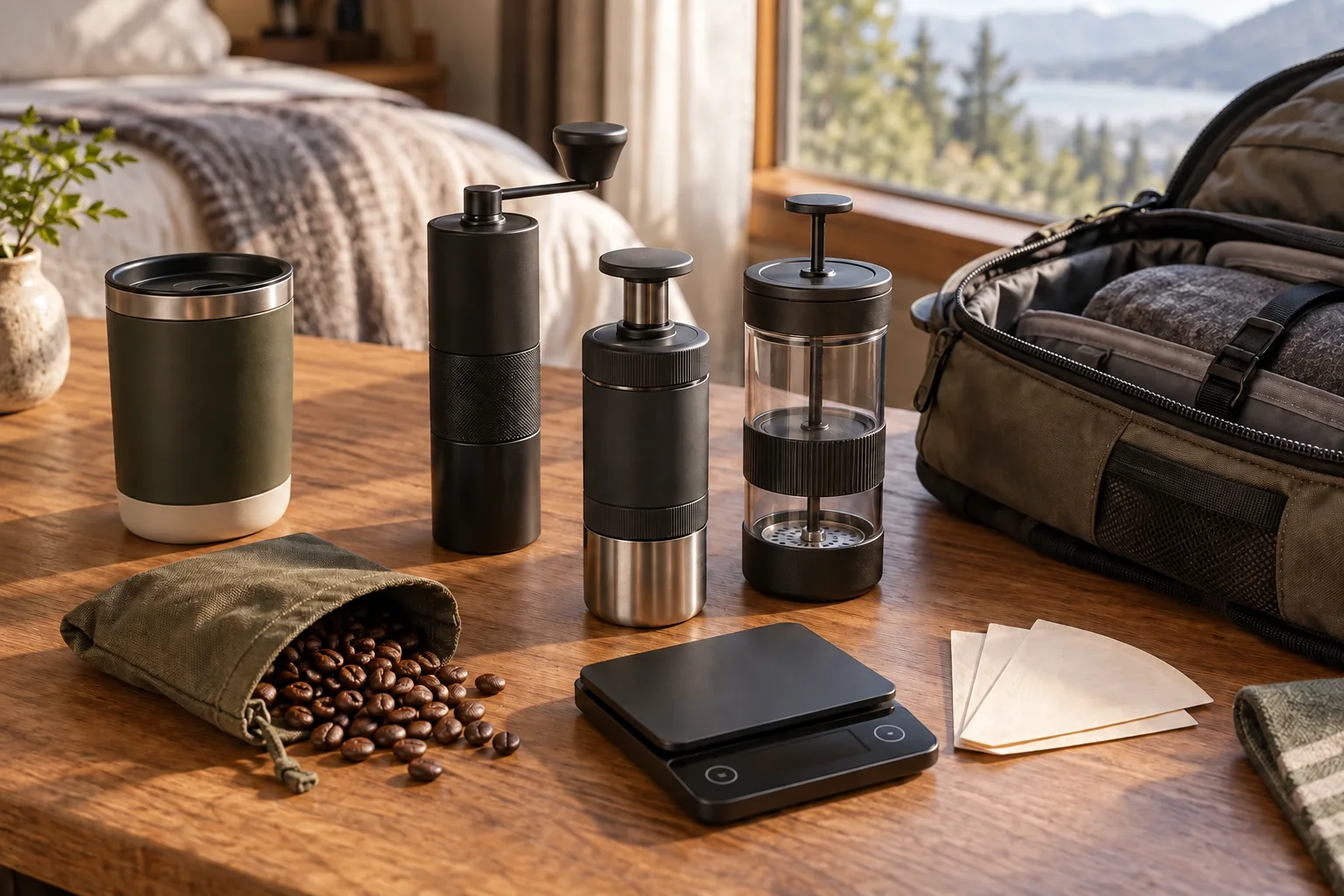
Bad hotel coffee is not inevitable, but the solution should not occupy half your carry-on. A good travel setup needs a heat source, a brewer that matches the drink you actually enjoy, and only enough precision gear to make the result repeatable.
We compared current manufacturer specifications with live retail demand and selected six products that solve different parts of the travel-coffee problem. This is researched curation rather than a claim that we personally tested every item, and we leave out prices because they change quickly.
The quick comparison
| Pick | Best for | Packed compromise |
|---|---|---|
| AeroPress Go | Most travelers and easy cleanup | Makes coffee or espresso-style concentrate, not café espresso |
| Wacaco Picopresso | Hands-on, unpowered espresso | Requires hot water, a capable grinder, and practice |
| OutIn Nano | Self-heating espresso on road trips and at camp | Heavier, battery-dependent, and limited to small servings |
| Timemore Chestnut C3S | Freshly ground beans without another charger | Hand grinding takes time, especially for espresso |
| Timemore Basic Mini | Repeatable recipes in little space | An optional luxury for casual coffee drinkers |
| Fellow Carter Move | Carrying brewed coffee without metallic flavor | Does not fit directly under an AeroPress |
For the majority of travelers, start with the AeroPress Go and pre-ground coffee. Add the Chestnut C3S when freshness and changing recipes matter enough to justify its weight. Choose a Picopresso only if true manual espresso is the priority, and the OutIn Nano when self-heating convenience matters more than packing light.
How we chose
Every pick had to earn its space by improving brewing, consistency, or spill protection. We favored products with published specifications, established replacement parts or consumables, broad brewing usefulness, and active listings on both Amazon US and Amazon Germany.
We also separated “portable” from “easy.” A manual espresso maker can be tiny but demanding; a battery brewer can be convenient but heavy. The right choice depends on whether you are flying, driving, camping, or simply trying to escape a hotel pod machine.
1. AeroPress Go: best overall
The AeroPress Go is the easiest recommendation because the brewer and accessories nest inside the included mug. According to AeroPress, the packed system weighs 11.4 oz (323 g), measures about 4.5 by 3.6 inches, and brews one 8 oz serving or espresso-style concentrate. It needs no power and cleanup is usually a quick press of the coffee puck followed by a rinse.
It is flexible rather than magical. The pressure is nowhere near a commercial espresso machine, so treat “espresso style” as a concentrated base for an Americano or milk drink. You still need a safe source of hot water, and paper filters must stay clean and dry. The included holder carries up to 20 filters, which is enough for many trips.
Best for: hotels, offices, camping, and travelers who want one forgiving brewer.
Skip it if: only true espresso will do, or you regularly brew more than one full cup at a time.
2. Wacaco Picopresso: best manual espresso
Picopresso is for someone who enjoys dialing in espresso, not merely caffeine delivery. Wacaco lists a 52 mm basket holding 18 g of coffee, an 80 ml water capacity, a net weight of 350 g, and dimensions of 71 × 78 × 106 mm. The pump is entirely manual, so there is no battery or voltage problem.
There is also no heater. You must add hot water, grind ultra-fine, distribute and tamp carefully, then pump with control. That makes Picopresso capable but less forgiving than the AeroPress. Its many small pieces need to be dried before packing, and a grinder that cannot make consistent fine adjustments will undermine the purchase.
Best for: espresso enthusiasts who already understand grind adjustment and travel with a kettle or hot-water source.
Skip it if: speed, one-piece cleanup, or a larger cup matters more than the ritual.
3. OutIn Nano: best self-heating option
The OutIn Nano removes the separate kettle from the equation. The manufacturer says it weighs 670 g, heats 50 ml of room-temperature water in about 200 seconds, and can make up to five cold-water brews per charge under its test conditions. It accepts ground coffee and compatible original-style capsules, while USB charging and 12/24 V car charging suit road trips particularly well. See the complete OutIn Nano specifications and caveats.
Convenience costs weight. At more than twice the packed weight of an AeroPress Go, Nano makes most sense when access to hot water is uncertain. Battery endurance drops when it must heat every serving; using preheated water dramatically extends the number of extractions. OutIn says to carry the device in cabin baggage and not use it during the flight. Check your airline’s current lithium-battery rules before departure.
Best for: road trips, campsites, holiday rentals, and espresso drinkers without reliable hot water.
Skip it if: you are an ultralight traveler, need several full-size coffees, or want a device with no battery.
4. Timemore Chestnut C3S: best travel grinder
Grinding immediately before brewing is the upgrade most likely to improve the aroma of good beans. The Chestnut C3S uses a 38 mm stainless-steel conical burr set with dual-bearing support in an all-metal body. Timemore’s current C3 series specifications cover settings from espresso through pour-over to French press, with roughly a single-cup capacity in the standard model.
The internal adjustment dial is compact but less convenient than an external ring when switching constantly between espresso and filter. Hand grinding an AeroPress dose is reasonable; grinding ultra-fine for Picopresso takes more time and effort. Record the number of clicks for each recipe in your phone instead of rediscovering the setting every morning.
Best for: coffee lovers who buy whole beans and use one or two brew methods on a trip.
Skip it if: you value minimum weight over freshness, have limited hand strength, or brew repeatedly for a group.
5. Timemore Basic Mini: best compact scale
A scale turns “one scoop and some water” into a recipe you can repeat. The Basic Mini combines 0.1 g increments with a timer and dedicated modes for espresso and pour-over in a small rechargeable body. Timemore describes a 760 mAh battery and IPX3 splash resistance on its Basic Mini product page.
It remains optional. For a three-day trip, pre-weighing beans at home or using the same level scoop can be a better use of luggage space. If you do pack it, switch it fully off, protect the weighing surface from pressure, and keep the charging cable with your other USB-C gear.
Best for: pour-over recipes, manual espresso, and travelers who notice small ratio changes.
Skip it if: your brewer has clear volume marks and “close enough” makes a satisfying cup.
6. Fellow Carter Move, 12 oz: best travel mug
The Carter Move is designed around coffee flavor rather than the look of a sports bottle. Its ceramic-coated interior limits metallic taste, the thin lip is comfortable to drink from, and a removable splash guard calms the flow while walking. Fellow lists a 77 mm body diameter, leakproof twist lid, double-wall vacuum insulation, and dishwasher-safe construction in its Carter Move specifications.
The important compatibility catch is also published by Fellow: the Move fits most standard drippers but not an AeroPress. Brew into the AeroPress Go cup or another sturdy vessel, then transfer the coffee. The mug is safest inside a bag only when the lid is correctly seated and tightened; always test a new seal over a sink before trusting it beside a laptop.
Best for: commuters, road trips, and travelers sensitive to metallic flavor.
Skip it if: you need to press an AeroPress directly into the mug or want the lightest possible cup.
Build the right kit for your trip
For carry-on city travel, pack the AeroPress Go, pre-ground coffee, and its paper filters. Use the hotel kettle and leave the grinder, scale, and second mug at home.
For a road trip, the OutIn Nano earns its weight because a car charger and bottled water make the setup self-contained. For specialty-coffee weekends, combine the AeroPress Go or Picopresso with the Chestnut C3S and Basic Mini. For camping, first confirm how you will heat safe water; no brewer compensates for a missing stove or an empty battery.
Avoid packing two brewers “for options.” Choose the cup you want to drink, run the whole workflow once at home, and count every loose part before leaving.
Hot water, batteries, and voltage
Manual brewers are international by default; kettles are not. A kettle designed only for 120 V can be damaged or dangerous on 230 V even when a plug adapter makes it physically fit. Use a hotel kettle, buy a properly rated dual-voltage device, or choose the self-heating Nano instead of assuming an adapter converts voltage.
Keep lithium-powered coffee gear in carry-on baggage when the maker or airline requires it, protect buttons from accidental activation, and never pack the device wet. Airline policies and security decisions can differ, so check the current rules for the exact battery and route.
Gifts for coffee lovers who travel
The safest gift is the AeroPress Go because it is complete, recognizable, and forgiving. The Carter Move is a strong choice for someone who already has a brewing method. Buy a Picopresso only for a recipient who genuinely likes espresso technique, and choose a grinder or scale when you know the equipment they already use.
Add the brewer, filters, coffee, grinder handle, charger, mug, and cleaning cloth as separate items in your journeybot packing list. “Coffee kit” is easy to check off while one essential part is still drying beside the sink.
FAQ
What is the best coffee maker for travel?
The AeroPress Go is the strongest all-round choice for most travelers because the brewer, mug, lid, scoop, stirrer, filters, and filter holder pack into one compact unit. Espresso drinkers may prefer the manual Picopresso or self-heating OutIn Nano.
Can you bring a coffee grinder in carry-on luggage?
A clean manual coffee grinder is normally straightforward to pack in cabin baggage. Battery-powered grinders and brewers need extra attention: protect them from accidental activation and check the current airline rules for their lithium batteries.
Can you use a portable espresso maker on a plane?
Do not plan to brew during the flight. Hot liquids, cabin rules, and battery-powered heating create avoidable risks, and OutIn explicitly says its Nano should not be used in flight. Pack it securely and brew after landing.
Should I travel with whole beans or ground coffee?
Whole beans preserve aroma longer and give you control over grind size, but a grinder adds weight. For a short trip, pre-weighed doses of freshly ground coffee in a sealed bag or container are the lighter and simpler option.